Firewall Redux
A hand coded Unity3D project reborn in the age of AI
I worked at a creative agency during the early Unity3D years. I was a software engineer on a creative team. My role included importing models and art assets from coworkers, and communicating with them on optimizations. It was my job to write the code to manipulate the models, and the entire application around that. We programed touchscreen applications for trade-shows for some pretty fun clients, Rolls Royce, Firestone Building Products, an array of Medical companies, Dow AgroSciences, Delta Faucet, and several others.
UI was absolutely awful in early Unity years
You had to decide early whether to do 2D UI or 3D UI. They were completely different systems. They weren’t remotely compatible with each other. We opted for 3D UI via an orthographic camera system with culling masks to several UI layers. This made translation from orthographic to the perspective camera’s 3D layers a bit easier to calculate.
Having gained a bit of real time training, my mind started to wander into pushing boundaries from impressive, eye-catching sales tools to something more challenging and interactive.
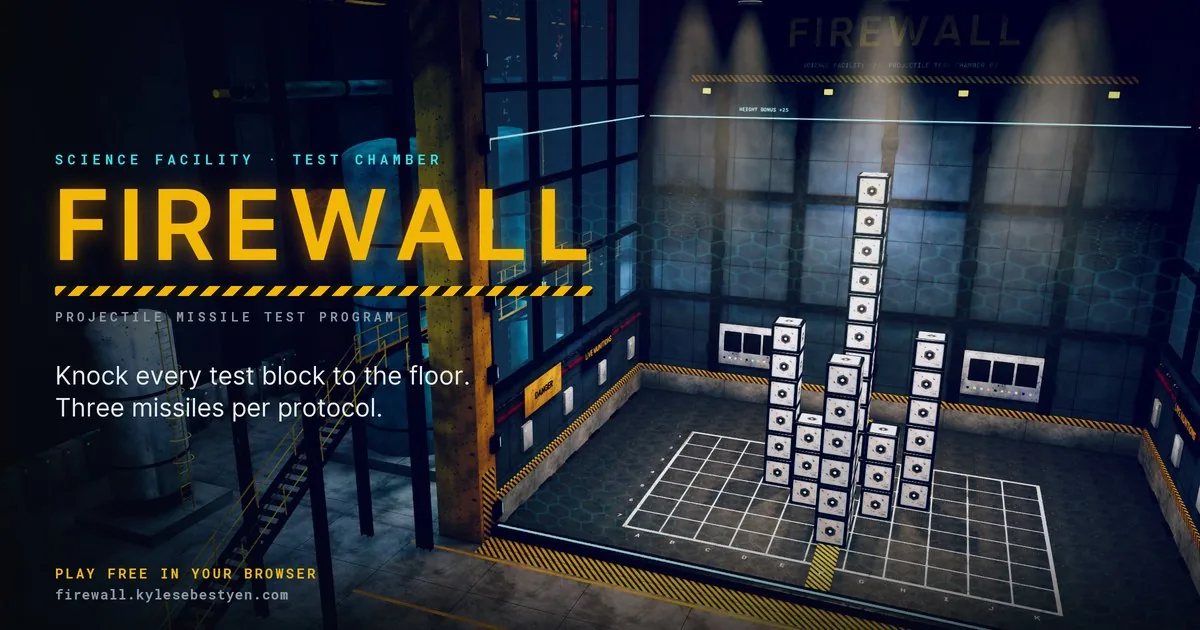
Firewall was inspired by an explosion asset bundle I discovered. It contained maybe a dozen prefabs with tweakable parameters that allowed me to dial in an explosion intensity and aesthetic that matched the idea in my head.
It fueled my creativity which led to shooting rockets at stacked cubes with rigid bodies.
My buddy Sean McDonald modeled missile.fbx while I worked on the projectile particles, the ray-casting, and the explosion prefab instantiation. I opted for a 2D UI implementation so that I would have some exposure to it.
One idea quickly gave way to the next; the cubes are green when touching the ground, you get points, limit to three rockets, the floor recoiling exposing the blocks to the incinerator, the JSON-backed level editor, the high score API with naive anti-cheat; it was very fun to build!
In the following weeks my friends and I played daily to attempt to dethrone each other from the scoreboard. It was quite a rewarding experience.
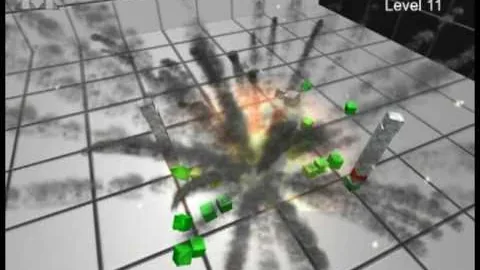 Play video: Firewall Redux
Firewall was ripe for a remake
I asked Opus 5.5 to modernize this using a workflow I’ve been tinkering with.
Unity MCP for game development
Blender MCP for 3d modeling
YuE2 Studio MCP for local music generation
Trailer-V MCP for local trailer generation
StableSFX MCP for local sound effect generation
This workflow allows me to pair with Opus and breathe life into an old idea
This workflow grows a bit each project. At the moment, Claude Code uses the Blender MCP to model mesh and render textures. It imports them into Unity via MCP and wires them into a prefab with materials and shaders. It uses the YuE2 Studio MCP to generate and import music, and the Stable SFX MCP to generate any sound effects it needs. YuE2 and Stable SFX are local models from Hugging Face.
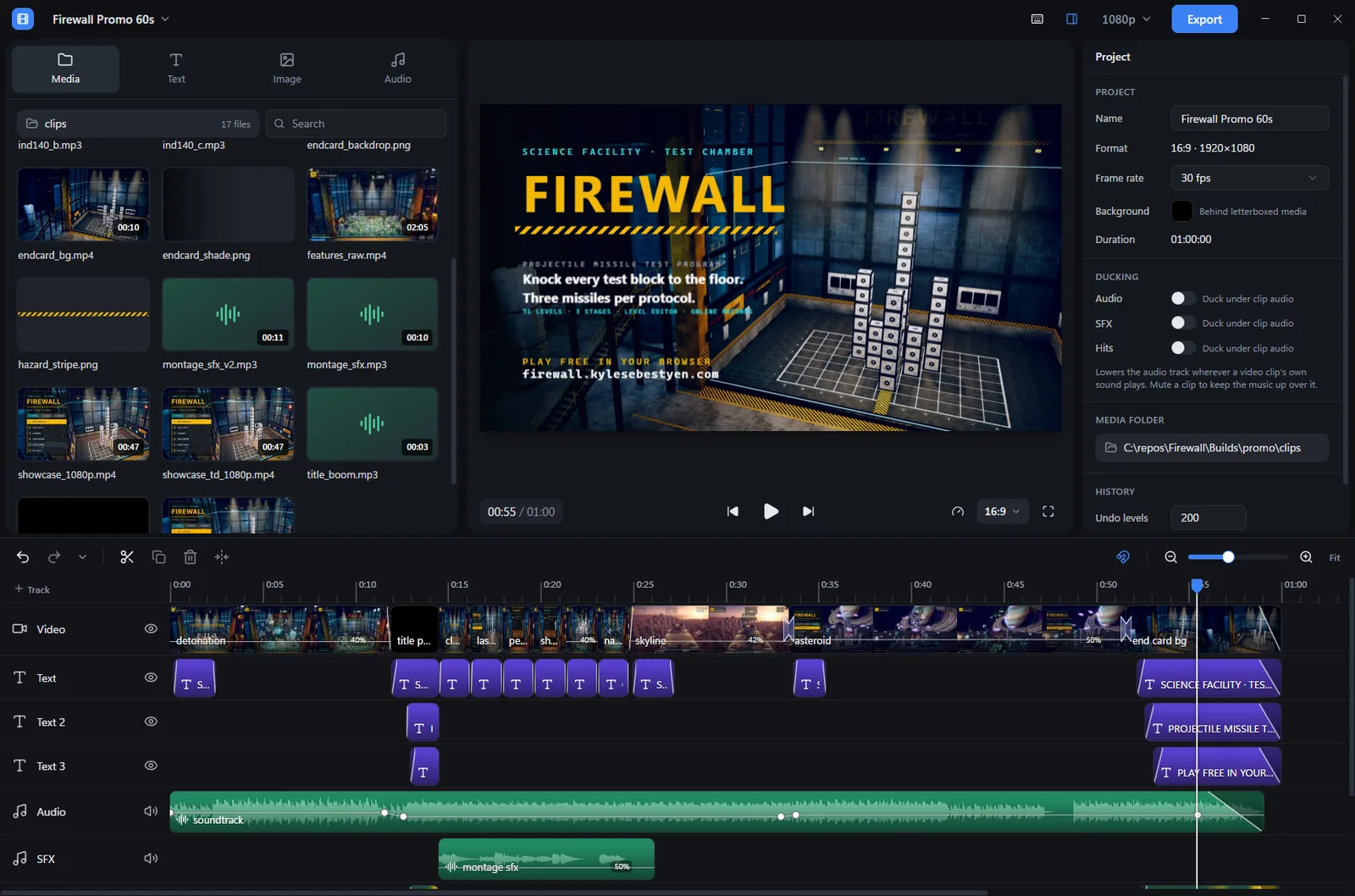
Here’s a screenshot from from the Trailer-V video that Claude made with it’s MCP.
Considering the tools as a living ecosystem that morph and change as I prompt Claude for new features is exciting. Hermes takes the approach automatically by asking “what tools could I create to make this easier next time”. Automatic tool suggestions would be an interesting retrospective for Claude to do within its hook lifecycle.
Like Flashwars, Firewall was mostly a one-shot port because I already had the source code. Having a strong foundation, whether that’s an existing code repository, or an articulate essay is like a strong input vector in the right direction. It gets you where you want to go.
I like to compare it to flying on a 737 vs throwing a paper airplane.
The chances of a paper airplane soaring from LAX to HNL from the power of my forearm are zero. It’s a weak idea pointed in the right direction, at the mercy of the winds of fate. It’s going into the ocean.
The vector is the journey.
A strong, clear idea is like a Boeing 737, with 26,000 lbs of thrust per engine, flexible wings, ailerons, elevators, advanced redundant navigation systems, topped off with fuel. Once you program the route from LAX to HNL into the system, it’s going to get there, fast! Even if you switch out the model.
 Play video: Firewall Redux